
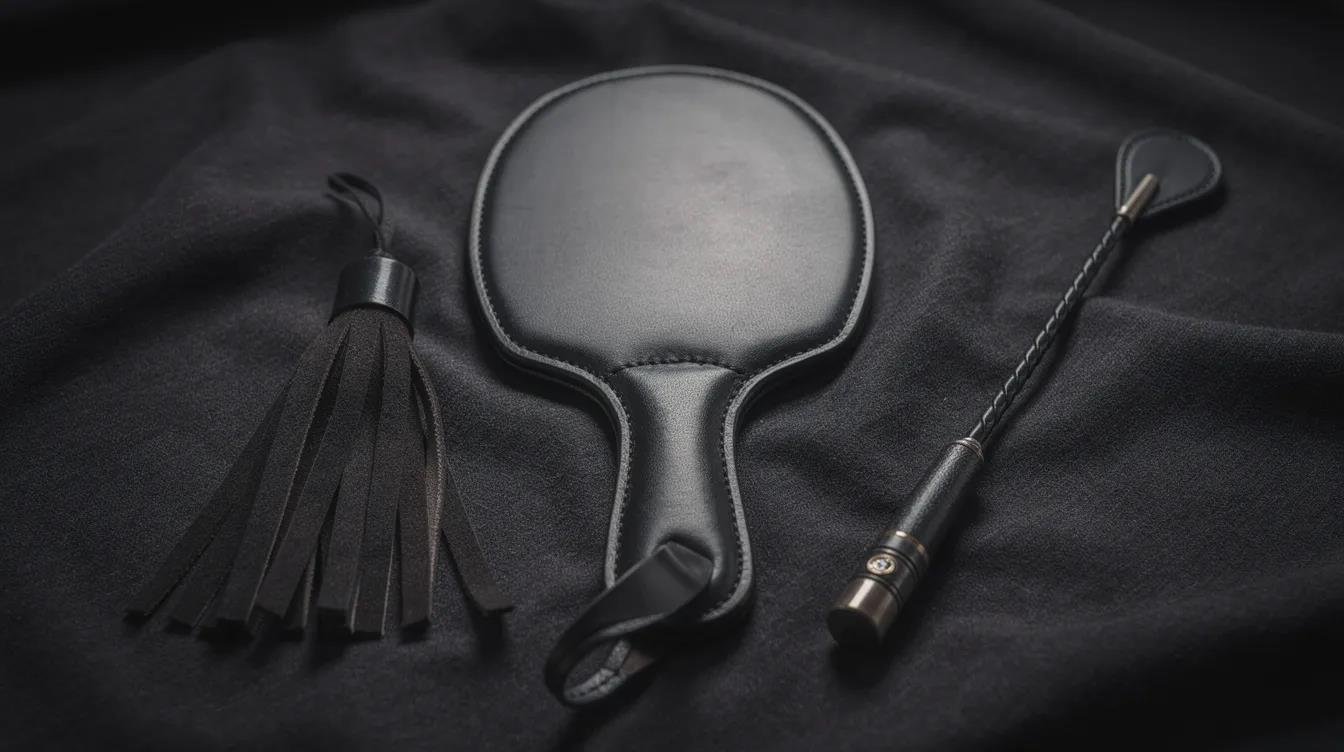
Choosing your first impact play toys can feel overwhelming when every guide seems to recommend something different. This article breaks down paddles vs floggers vs crops side by side, covering sensation profiles, materials, safety, and learning curves so you can pick the right tool for your skill level and preferences.
Key Takeaways
- Bare hands are usually the true first impact toy; they let you feel force directly and create a personal connection with varying intensity levels before adding any implement.
- Paddles deliver broad, thuddy or spanky sensations and are the easiest to aim; floggers offer diffuse, warm, rhythmic impact; crops produce focused, sharp, stingy hits.
- Start with a padded paddle or soft flogger. Riding crops are better kept for later, once you and your partner can aim on fleshy zones and communicate about sting.
- Control and safe zone awareness matter more than the specific impact tool, especially for new players.
- Materials, construction quality, and proper aftercare all reduce risk and improve the overall experience.
What Is Impact Play (and Why Paddles, Floggers, and Crops?)
Impact play involves striking the body consensually for sensation and intimacy, not for injury or harm. The practice traces back centuries; erotic flagellation appeared in European "flogging schools" as early as the 17th century, and today's community has refined the tools and safety practices considerably.
Common impact play tools include paddles, floggers, and riding crops, each offering different types of sensations and learning curves. This article focuses on comparing those three as beginner-friendly options rather than advanced tools like canes or whips. Canes can produce extreme high-intensity strikes with both sting and thud, which makes them a poor starting point. The same goes for single-tail whips.
Bare hands remain a valid and valuable impact tool even after you buy "proper" toys. Hands can create a personal connection with varying intensity levels, and many experienced players return to them regularly. A SparkChambers survey found that roughly 60% of respondents had fantasized about giving impact, and about 65% about receiving. If that curiosity describes you, the various tools covered here give you a structured way to explore it.
Start Here: Talk First, Toy Second
Negotiation comes before choosing any impact toy, even a gentle paddle or a soft flogger. Impact play requires clear communication and consent, and skipping this step turns a pleasurable scene into a risky one.
Communication about boundaries and intensity is crucial in impact play. Discuss boundaries and desires before engaging in any session. Negotiating boundaries should be a collaborative process; both partners talk through:
- Hard limits: body parts or sensations that are absolutely off the table.
- Soft limits: things you might explore slowly, with extra check-ins.
- "Maybe" limits: curiosities neither person is sure about yet.
Establish a safeword to halt activities if needed. The traffic light system works well: green means "keep going," yellow means "slow down or ease up," and red means "stop now." Add a non-verbal signal (dropping a held object, two firm taps) for moments when talking isn't possible. Communicate limits and safe words before impact play starts, not during.
Regular check-ins during play maintain comfort and trust. Simple mid-scene questions like "How does this feel?" help calibrate intensity, especially when increasing force, switching tools, or moving to a new zone. Consent is ongoing and can be withdrawn at any time, regardless of the toy being used.
Safe Zones vs No-Go Zones for Beginner Impact Play
Anatomy and target selection matter more than which impact tool is in your hand. Getting this wrong with any paddle, flogger, or crop can cause injury.
Safer impact zones:
- Buttocks (gluteus maximus): thick muscle and fat layer, rounded shape distributes force well
- Backs of thighs (hamstrings): large muscles, though more sensitive than the glutes
- Fleshy upper back and shoulders (avoiding the spine): where muscle padding absorbs impact
Danger areas to avoid:
- Spine, tailbone, and vertebrae: nerve and vertebral injury risk
- Kidneys (lower back, lateral sides) and lateral ribs
- Hip bones, joints (knees, elbows), back of knees
- Neck and face: risk of swelling, breathing issues, or structural damage
Beginner safety requires avoiding vulnerable areas like the spine and joints with every implement. Avoid striking sensitive areas like the spine and kidneys regardless of how soft the toy feels. Start on the fullest part of the buttocks and upper thighs with all three impact play toys for predictable, fleshy targets.
If impact leads to broken skin, numbness, loss of movement, or pain lasting more than a few days, seek medical attention.
Thud vs Sting: The Sensation Scale That Matters
"Thuddy" versus "stingy" is a more useful framework for comparing impact toys than simply listing toy names. Impact play sensations vary based on the implement's material, weight, and design, so the same category of toy can sit at different points on the scale.
Thuddy sensations resonate deeply through the muscle. They feel deep, dull, and diffuse; think of the warmth that spreads after a firm, flat-handed pat. Heavy suede floggers, broad padded paddles, and large, soft surfaces all lean thuddy. Heavier impact toys generally produce a thuddier sensation because their mass transfers energy into tissue rather than across the skin surface. The weight of a toy influences thud versus sting sensations more than almost any other variable.
Stingy sensations are sharp and surface-level. They bite at the skin and fade faster. Slim paddles, small crop tips, and narrow striking areas create sting. Faster swing speed also pushes any toy toward the stingy end of the scale.
Different types of impact toys can all be tuned thuddy or stingy depending on weight, width, material, and how you swing them. A thick leather paddle swung slowly feels felt deep in the muscle; the same paddle flicked fast across the skin stings. Beginners should start closer to the thuddy, diffuse end and add sting only when both partners are enthusiastic.
Paddles: Forgiving All-Rounders for New Players
Paddles are solid implements typically made of wood, acrylic, leather, or silicone. A paddle is a solid piece of flat surface attached to a handle, and most paddles share a straightforward design that keeps the learning curve low.
The broad face of a paddle spreads impact across a wider area, making aim easier and mistakes less likely to land on bones or joints. Paddles are easier to aim than floggers or crops because the striking surface is large and predictable. Paddles provide high surface pain with reduced risk of damage compared to focused tools like crops.
Sensation range varies by material. A soft, padded or silicone paddle leans thuddy; a slim wooden paddle or a thin leather paddle leans stingy or "spanky." Paddles typically provide a sharper impact than floggers when used at the same force, though paddles generally provide a thuddier sensation due to their broad surface when compared to crops. The key variable is thickness and material rather than the paddle form itself.
For control and learning curve, paddles are intuitive. Short swings, clear sightlines, and predictable arcs make them a popular choice for first-timers. Watch your partner's reactions after each strike and adjust force before the next.
Beginner paddle specs to look for:
- Face size: 6 to 10 inches
- Smooth surface, no holes (holes increase sting and reduce forgiveness)
- Moderate weight; avoid extremely dense wood
- Comfortable handle with a wrist strap
- Price range: $20 to $80 depending on material
Avoid an evil stick, slim wooden spoons, or paddles with cutouts until you have several sessions behind you. Those stingy toys concentrate force in ways that surprise beginners.
Floggers: Diffuse, Rhythmic, and Beginner-Kind (With One Catch)
Floggers are impact play toys with multiple tails, called falls, attached to a central handle. The number, length, width, and material of those falls determine the sensation profile.
Floggers provide a warm, diffuse thud sensation when built with soft materials. A heavy suede flogger with 14 to 20 falls, each about 12 to 16 inches long, delivers a rhythmic warmth that builds over repeated swings. Floggers can deliver both thuddy and stingy sensations; soft, wide falls lean thuddy, while thin, stiff falls cut toward sting. Floggers deliver a range from thuddy to stingy sensations based on technique and materials. Swing speed and wrist snap also shift the balance.
The main catch is wrap. Wrap happens when the falls curl around the body and strike unintended areas like the ribs, hips, or kidneys. Shorter falls and slower swings reduce wrap risk. Practicing on a pillow first helps you learn where the tails land at different distances.
Beginner flogger specs:
- Falls length: 12 to 16 inches
- Falls count: 14 to 20
- Material: suede or deerskin for a softer feel
- Secure handle with comfortable grip
- Quality beginner floggers typically cost $35 to $100
Floggers can deliver both thuddy and stingy sensations based on technique, so a single soft suede flogger covers a wide range of play as you gain experience.
Crops: Precise, Stingy, and Better After Some Practice
A riding crop consists of a stiff shaft (usually fiberglass or plastic) ending in a small leather or synthetic tip. Crops consist of a rigid shaft ending in a flexible popper or lash, and they originally served as horse-riding tools before finding a second life as impact play implements.
Crops deliver a precise, stingy sensation. The small tip concentrates force into a compact area, producing a sharp snap on the skin with relatively little effort. Crops create a sharp and precise impact requiring accuracy and control. Crops are designed for precise, stingy impacts on the skin, which makes them effective for accent hits during a scene but demanding on your aim.
The small striking surface means a slight miss can land on a hip bone, the back of a knee, or another danger zone. Crops are usually not the best first impact tool, but they work well once you are comfortable reading your partner's body and communicating about different sensations.
First crop specs:
- Total length: 24 to 30 inches (shorter if your play space is small)
- Simple flat tip (leather keeper flap rather than a pointed design)
- Flexible shaft; avoid anything too stiff or metal-cored
- Non-slippery handle, ideally with a wrist loop
- Price range: $20 for basic synthetic up to $100+ for leather and custom work
Materials and Construction: How Your Impact Toy Is Built
Materials and build quality affect sensation, control, durability, and safety of every impact play toy. Impact toy material affects sensation; leather feels different from wood, and both feel different from silicone or rubber.
Material Typical Toy Sensation Tendency Care Notes
Wood (maple, oak) Paddle Stingy to thuddy depending on thickness
Sand smooth; check for splinters
Leather (cowhide, Latigo)
Paddle, flogger, crop tip Versatile; medium thud Condition periodically
Suede / deerskin Flogger Soft, thuddy Avoid moisture
Silicone Paddle Can be intense if thin; easy to clean
Body-safe; wash with soap and water
Rubber Flogger falls, crop tip Sharp, stingy Better left for experienced players
Plastic / acrylic Paddle, crop shaft Stingy, light, rigid Check edges for burrs
Vegan leather Flogger, paddle Varies; generally softer Growing availability
For crop construction, secure joins between shaft and tip are crucial. A tip that detaches mid-swing is a safety hazard. Check that the handle doesn't wobble and that the shaft flexes smoothly through the air without unpredictable whip.
Quality checks for any toy: smooth edges, no splinters, no peeling or cracking, secure handles, and body-safe finishes. Avoid anything held together with glue alone.
Control, Warm-Ups, and Learning Curve for Each Impact Toy
Technique and control can make the same impact tool feel gentle or harsh. Each impact tool has unique beginner considerations based on its design.
Every impact play session should begin with a warm up: slow, light strokes to bring blood to the skin and check comfort levels. Warming up increases blood flow and tissue flexibility, reducing the shock of heavier hits later. Starting with lighter tools helps to gauge sensitivity before increasing intensity. Building intensity gradually over the first several minutes sets the tone for the rest of the session.
Control comparison:
- Paddles: predictable swing arc, easy to control force, short learning curve
- Floggers: require practice with distance and wrist action; the falls move through the air in arcs that shift with speed and angle
- Crops: precise but unforgiving; a small error in aim lands the tip on bone or joint
Practice methods:
- Try each toy on your own forearm or thigh to sense how it lands
- Swing slow on a pillow to learn the arc and landing point before using it on a partner
- Start with shorter toys and small swings; add range and force as your skill grows
Other Factors That Shape Your Impact Play Experience
Toy type is only one piece of the puzzle. Other factors change how impact feels in practice.
Partner experience and pain tolerance vary. Beginners may prefer a thuddy toy and shorter sessions regardless of which implement is in play. Preferences shift over time, and what feels like too much sting in session one may feel perfect by session five.
Environment matters: privacy, room temperature, and the surface your partner rests on (bed, bench, or lap) all affect relaxation and body positioning. A cold room tenses muscles and makes skin more sensitive.
Psychological elements shape perception of intensity. Roleplay, ritual, and simply showing the impact toys before using them heighten anticipation and can make a light tap feel heavier. The sense of anticipation itself is part of the play.
Hydration, avoiding alcohol or drugs, and checking in about health conditions (bruise-prone skin, blood thinners, recent injuries) all contribute to safer sessions. These details are easy to overlook but match the importance of choosing the right toy.
Choosing Your First (and Second) Impact Play Toy
Start with bare hands. They cost nothing, they give you direct feedback, and they let you practice reading your partner's reactions before any implement enters the scene.
Simple decision path:
- If you want easy control and classic "spank" sensations, choose a paddle. A medium leather or
silicone paddle at regular price ($20 to $60) covers a wide range of intensity.
- If you want diffuse, rhythmic impact with a softer feel, choose a soft suede flogger.
- Wait on a crop until you are comfortable aiming on fleshy zones and communicating about
stingy sensations.
Build a small collection over time. One paddle, then one flogger, then a crop. Buying everything at once leaves you juggling tools you haven't practiced with. Choose quality over quantity, read product details closely, and, where possible, feel weight and balance before purchase to match your preferences.
Aftercare: What to Do Once the Impact Play Stops
Aftercare supports both physical recovery and emotional processing after impact play, no matter which toy was used.
Physical aftercare:
- Hydrate; offer water and a light snack
- Check the skin for bruises, welts, or broken surface
- Apply a cool compress for heat or a warm compress for deep soreness
- Clean toys with appropriate wipes or soap
Emotional aftercare:
- Cuddling, blankets, gentle touch
- Talking through what each person liked or didn't about each impact toy and each body part that was struck
- Watching for "sub-drop" (emotional vulnerability hours or days after a session) and addressing it with reassurance
Tops and givers also need aftercare. Reassurance, rest, and hydration matter after intense focus or worry about using a new impact tool. A short follow-up the next day (a text or call) to check how bodies feel is especially useful after trying new paddles, floggers, or crops for the first time.
FAQ
Is a paddle, flogger, or crop safest for a complete beginner?
Bare hands are absolutely the safest starting point. After that, a padded paddle or a soft beginner flogger offers broad, forgiving impact areas and simpler control. Both spread force across a wide surface, which reduces the chance of accidentally hitting a bony or vulnerable area. Crops require more precision and are better once you have a few sessions of experience.
Can I use a riding crop as my very first impact play toy?
You can, but it is not ideal. Crops deliver focused, stingy impacts through a small tip, which makes it easier to accidentally strike unsafe zones like hip bones, joints, or the back of the knee. Without practice, even a gentle flick can land in the wrong spot. Build your aim with a paddle or flogger first, then add a crop once your control is solid.
How do I know if an impact toy is too intense for my partner?
Start with gentle taps and watch body language closely: flinching away from the strike zone, tensing without relaxing, or going quiet after previously vocalizing can all signal discomfort. Use your safe words or traffic-light system, and check in when you change from thuddy to stingy sensations or switch to a new toy. If your partner says yellow, ease up immediately. If red, stop entirely.
Do I need different safe zones for paddles, floggers, and crops?
The main safe zones (buttocks, backs of thighs, upper back with muscle padding) apply to all three. Crops require extra caution because their focused, sharp impact can cause disproportionate pain on bony areas or joints. Floggers carry wrap risk, so keep swings controlled to avoid tails landing on ribs or kidneys. Paddles are the most forgiving on aim, but still stay away from the spine and tailbone.
How much time should I leave between impact play sessions?
Give the body at least a day or two to recover, especially after a session that left visible bruises or soreness. Inspect the skin before the next session. If bruising hasn't faded or tenderness remains, wait longer. Adjust frequency as experience grows and both partners feel comfortable with their impact toys and intensity levels.